
Based on research conducted by Effortless Engagement (The Value Gap – worth a read), clients defined a successful financial advice relationship as one where they achieve “their goals and objectives in their desired time frame”. Following we look at some of the ways this has been addressed in the industry to date, and why Beegle is the way forward in delivering this value to clients, while still being conscious of adviser efficiency and capacity (watch this space…).
Performance Monitoring
A simple approach is to simply review the investment returns generated by the client over 12 months and compare that to their risk profile or assumed rate of return in the financial projections. If performance has exceeded expectations, it may be an indication of meeting the client’s goals.
However, performance is only a small part of overall financial progress. Strategies around how cash flow is utilised can also play a crucial role, as we have experienced in the case study later in this article.
Another issue with performance, which we have been fortunate enough not to experience for over a decade, is significant negative returns. How is this topic broached with the client without causing panic or emotionally fuelled financial decisions? If there is a negative return, how do we calculate the return needed next year to make up the shortfall?
Beegle can move the conversation away from investment returns in these cases, instead focusing on answering the most important question from the client: Am I on track to achieve my goals? We have seen many examples where short term performance is lacklustre, but as soon as we demonstrate to the client, they are still on track to achieve their goals, all their concerns fade away and they trust in the financial advice process. With Beegle you can also immediately see how far a client is behind target and take appropriate action. E.g. if a client is $10,000 behind target, lets discuss whether we can allocate $100 per week over the next 2 years to catch up.
Rerun Financial Projections
Another approach is to rerun the client’s financial projections every year. But the question must be asked whether this delivers any value relative to the time spent, when the clients situation has been stable. In these cases, it is far easier to simply compare where they are financially versus expected. This is exactly what Beegle achieves with its dashboards and charting.
In addition, even if a client’s situation has changed, but their goals remain the same, the end target is unchanged and careful consideration should be given between rerunning financial projections, or just continuing to track against existing projections.
Basic Traffic Light System
This one comes in various flavours, but essentially a target balance and date is set, a straight line drawn between start and end point, and the current balance compared to that straight line.
As we know, finances are rarely a straight line. There are other complications too such as different tax rates for different entities, accounts and structures. Often there is no end target, for example retirement funding doesn’t stop at age 67.
Beegle overcomes this by allowing you to import comprehensive financial forecasts in an efficient manner. You can then link these projections to any number of goals: maybe an investment account will be used to fund a holiday and early retirement. Beegle allows you complete flexibility in how you link together actual accounts, projected accounts and goals.
Client example
Earlier this year we had an annual review with a client. Based on the client’s risk profile, we assumed average annual returns of 4.59% pa for their superannuation accounts. Over the last year their super funds generated 7.94% and 9.39%. In fact, this level of outperformance has occurred for the last three years.
However, these clients are only just ahead of projected superannuation per the below screenshot.
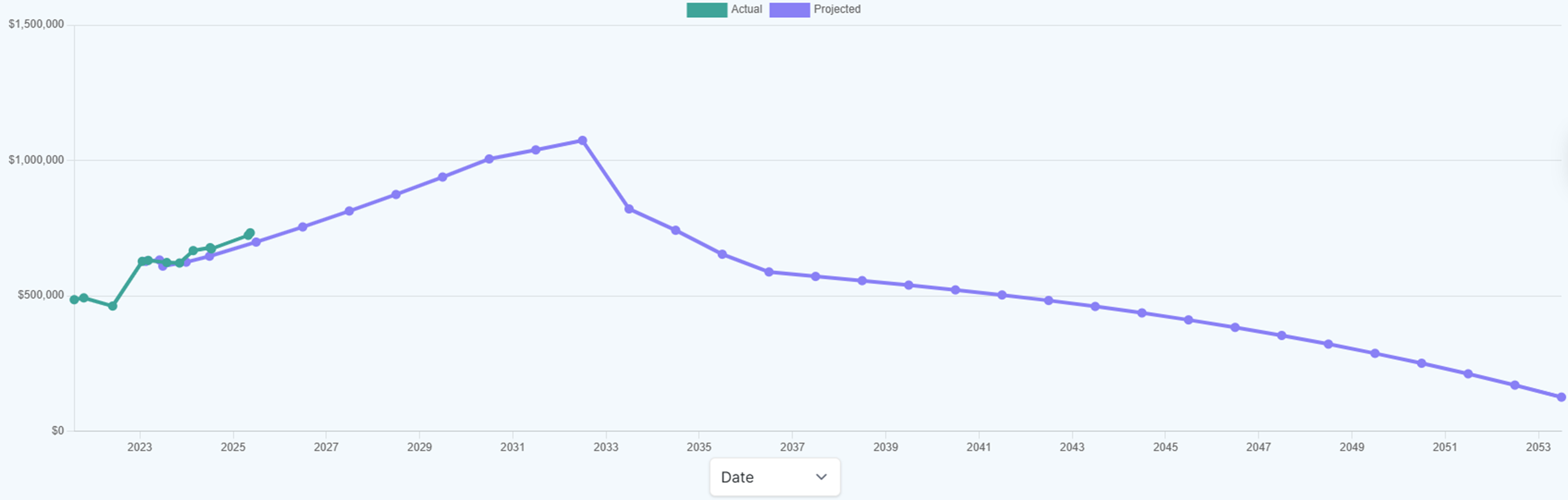
The reason for the discrepancy: when mortgage rates started increasing the clients ceased additional superannuation contributions. So in effect, these higher than normal investment returns have only just been making up for the missing contributions. So, investment performance alone cannot be used to determine if your clients are on track.
Beegle overcomes this in several ways:
- The tracking of goals and finances. As demonstrated above, when seeing returns so far ahead of assumptions it begs the question: Why are we not getting ahead?
- Beegle has a list of all past, current and future financial strategies under consideration. For this particular client, we simply toggle the super contribution strategy from ‘In progress’ to ‘To consider’ so we have a constant reminder to re-implement the strategy.
- In our development pipeline we have some useful and exciting features that will highlight these issues even further.
Finally, with this client, once we demonstrated we are only on track due to unusually good performance they decided to reinstate the additional super contributions, which will ultimately deliver a good outcome for them.